

America’s First “Trail of Tears”
The Story of The Choctaw-Apache Tribe of Louisiana, Toledo Bend Lake
HARD COPY SOLD OUT – DIGITAL VERSION E-EDITION COMING SOON!
$5
All credit cards taken
THANK YOU,
To Contact the author:
Dorsey Ebarb Bronson
E-Mail: dorseybronson@ymail.com
251-604-1832
- Part I – Roots (290 years)
- Part II- Remedies
- Part III – Recipes
- Genealogy of Tribal Families
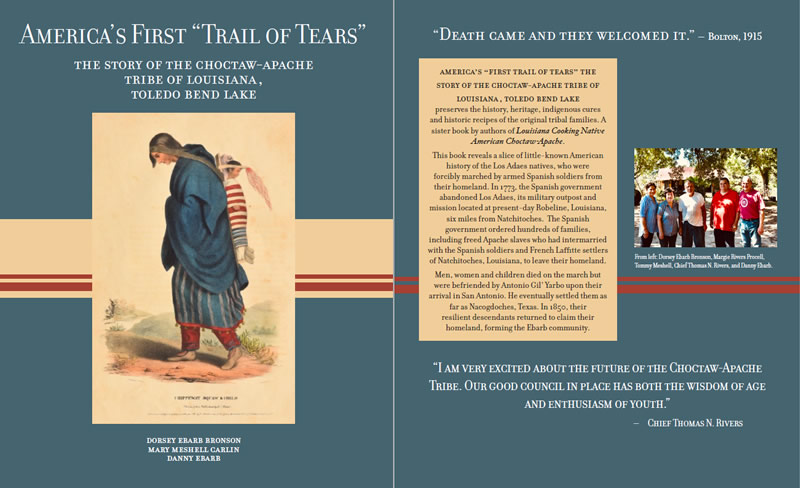
America’s First “Trail of Tears,” The story of the Choctaw-Apache Tribe of Louisiana, preserves the history, heritage, indigenous cures and historic recipes of the original tribal families.
This book reveals a slice of little-known American history of the Los Adaes natives, who were forcibly marched by armed Spanish soldiers from their homeland. In 1773, the Spanish government abandoned Los Adaes, its military outpost and mission located at present-day Robeline, Louisiana, six miles from Natchitoches.
Los Adaes served as the first capital of Spanish Texas (1729-1773) and was located 30 miles east of the Sabine River in northwestern Louisiana.The families of Los Adaes, freed Apache slaves who intermarried with the French and Spanish locals, were ordered to leave in five days by the Spanish Governor. They left their crops in the fields and began a 400 mile trek to San Antonio. Many men, women and children died on this first “Trail of Tears”.
Two months later, the refugee survivors arrived in San Antonio without a place to settle. A young Spanish soldier, Antonio Gil Y’barbo (1729-1809), who was born at Los Adaes and married to a part-Indian wife, befriended them. He received permission from the Spanish Government to take charge of the people. He eventually was able to move them back toward their homeland, settling them for over 50 years in Nacogdoches, Texas. New generations were born, including the Choctaw great grandmother of the three book authors, Dorsey Ebarb Bronson, Mary Meshell Carlin and Danny Ebarb.
After the death of Y’barbo, in 1850 his grandson, Alcario Ebarb, led the descendants of Los Adaes natives back to their ancestral homeland in the piney woods wilderness of northwestern Louisiana near modern-day Toledo Bend Reservoir. The story of the Choctaw-Apache Tribe of Louisiana, in addition to telling the shameful tale of a suffering people, captures in photographs how they lived in their ancient land. The book also features the life-saving herbs and plants and many of their historic made-from-scratch recipes.
About the Book
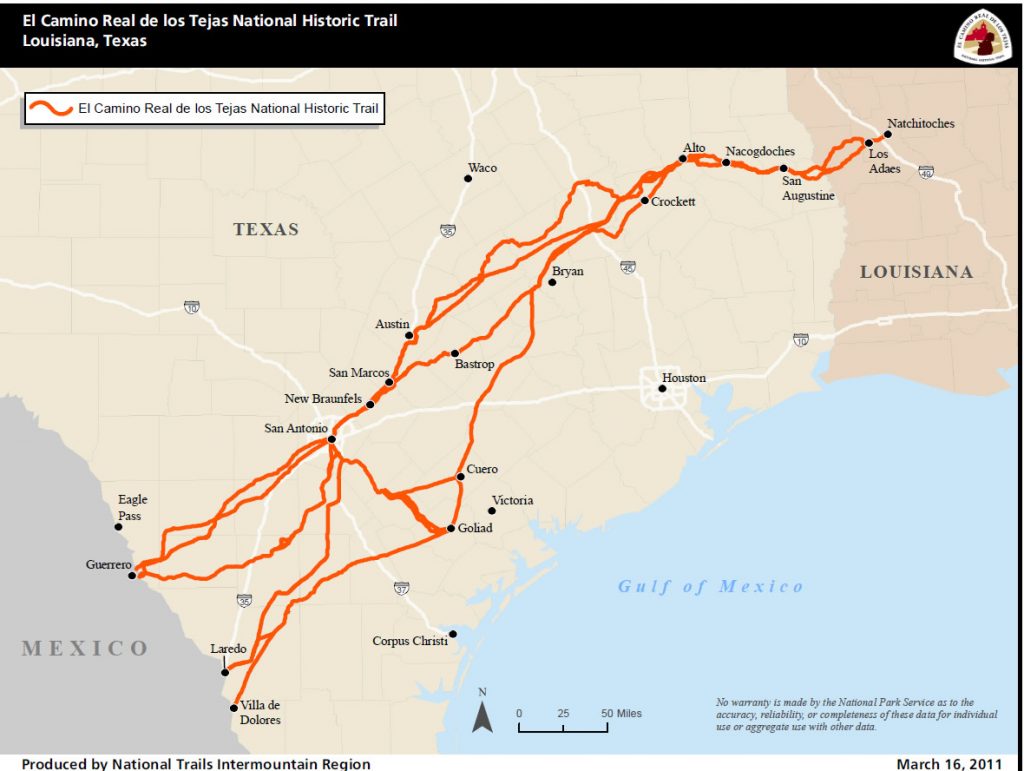
In 1773, the people of Los Adaes, freed Apache slaves who intermarried with French and Spanish families were forcibly marched by Spanish armed soldiers from their homeland around Natchitoches, Louisiana to San Antonio. Many men, women and children died on the 400 mile journey on foot. They were guarded by cannons drawn by bison, to keep them from running away.
INDIGENOUS CURES

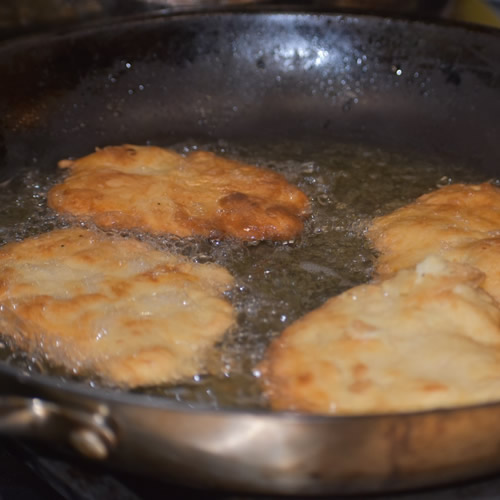
HISTORIC RECIPES
About the Authors
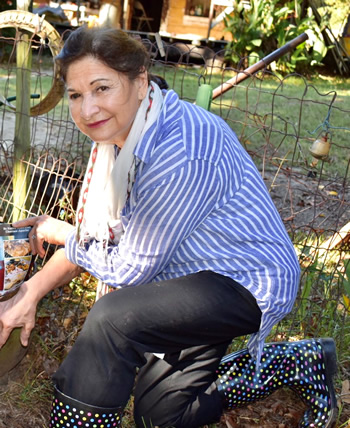
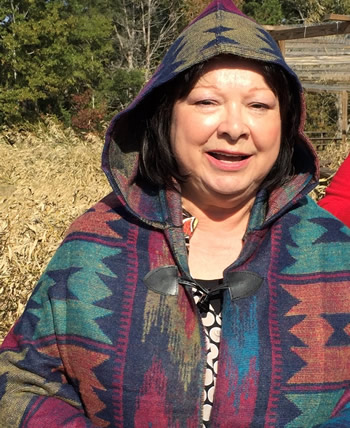
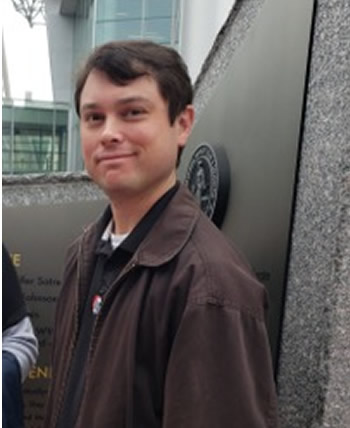
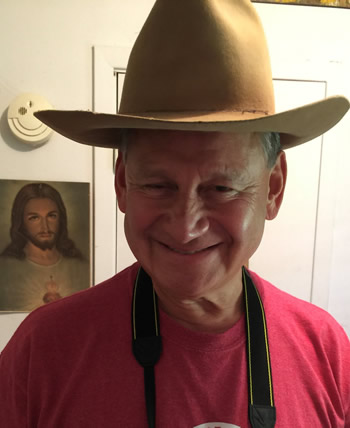
Choctaw-Apache Authors Preserve History, Life-Saving Remedies and Ole Timey Recipes In Book
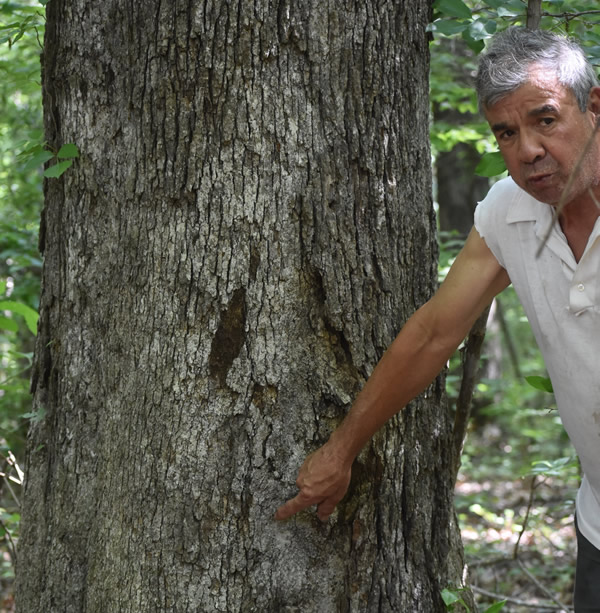
Toothache Remedy-
Tommy Meshell points to missing piece of bark from oak tree on Ebarb ancestral land. Decades ago he removed a splinter from the inside of the bark and applied it to the gum of his painful tooth to stop the pain. A remedy found in America’s First “First Trail of Tears.”
THE JOURNEY Of THE CHOCTAW-APACHE
“Into the No Man’s Land”
by Matthew Carlin
The story of the Choctaw-Apache Tribe weaves into the neglected history of the borderlands between Louisiana and Texas. Upon these grounds around the Sabine River, known to the Spanish as Rio de Sabinas (or Cypress River), our people’s saga reaches a powerful episode, when a dark turn tested the persistence of a strong community.
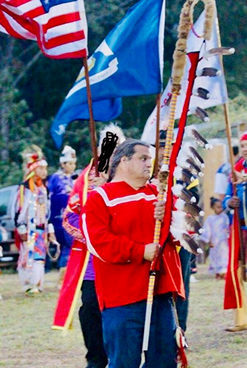
Chief Thomas Rivers is the elected chief of the Choctaw-Apache Tribe of Louisiana. It is the second largest state recognized tribe in Louisiana. He is pictured at the annual November Powwow leading the Veterans Day flag ceremony.
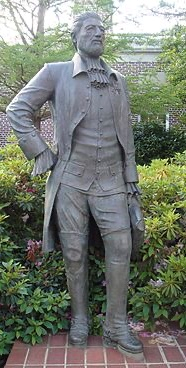
In 1773, Don Antonio Gil Y’barbo (1729-1809) befriended the refugees who had been forcibly marched by armed Spanish soldiers, from their Los Adaes homeland. The Spanish government would not allow the people to return to Louisiana but granted Y’barbo permission to settle them at an abandoned Spanish fort in Nacogdoches, Texas. Over 50 years later, Y’barbo’s grandson, Alcario Ebarb, led the descendants of the Los Adaes natives to their ancestral land forming a community that evolved into Ebarb. Alcario is the great grandfather of there book authors.
Book Reviews
“I searched for this book, America’s First “Trail of Tears,” The Story of the Choctaw-Apache Tribe of Louisiana on Toledo Bend Lake. I want to sell it in Books Along The Teche.”
– Lorraine Kingston, New Iberia, Louisiana.
“Thank you so much for capturing our Native American culture/history in those two wonderful books.” Please accept this Army Coin as a token of appreciation for your support to our Great Nation and the Men and Women who defend our Freedon111” God Bless y’all.”
– Joe and Lynne Sepulvado-Kansas
“My staff and I have been leafing through the wonderful images and the recipes. It will be a valuable addition to the museum’s collection, as we have many Choctaw baskets. Looking forward to meeting you.”
– Nita K. Cole, Curator and Archivist Louisiana State Exhibit Museum-Shreveport
“Yes, the we are interested in your new book and want to sell in the French Market.”
– Linda Henderson, Natchitoches, La.
“Dorsey, I received your book today and it is truly wonderful. What a wealth of information y’all have packed into it and pictures are really nice.”
– R. Martin Guidry- Baton Rouge
“We are looking forward to adding these to our collection. Thank you for your efforts to write this book.
– Howard L. Coy Jr. Vernon Parish Library
“Good Afternoon, Mrs. Dorsey, I received the book. Great Job! I love the photos and I love that you included Jana (my best friend from school). “
– R. Cody Bruce PhD (c), MSN Ed, RN,CNE- Round Rock, TX.
“We look forward to your presentation on the history of the Choctaw-Apache Tribe at the opening of the Zwolle Railcar Museum during the annual October Zwolle Tamale Fiesta. “
– Edith Palmer, Zwolle
“Dorsey, will you work on the Choctaw-Apache exhibition for the new Many Railcar Museum opening next year? You will be teaming up with Robert Caldwell.”
– Mary Brocato, Many Alderwoman at Large.